
What if the most consequential energy decision in a 700-hectare development is the one made before a single foundation is poured?
Every building eventually gets built, occupied, renovated, sold. Buildings are reversible. Energy infrastructure is not. The thermal strategy chosen for a large development – how heating and cooling will be generated, distributed, and paid for – gets buried under streets, embedded in basements, and written into contracts that outlive the people who signed them. Whatever residents pay for comfort in 2050 is being decided now, in a feasibility model, long before anyone moves in.
This is the problem we were asked to think through at The Ellinikon – Europe’s largest urban regeneration projects.
A city asking a city-sized question
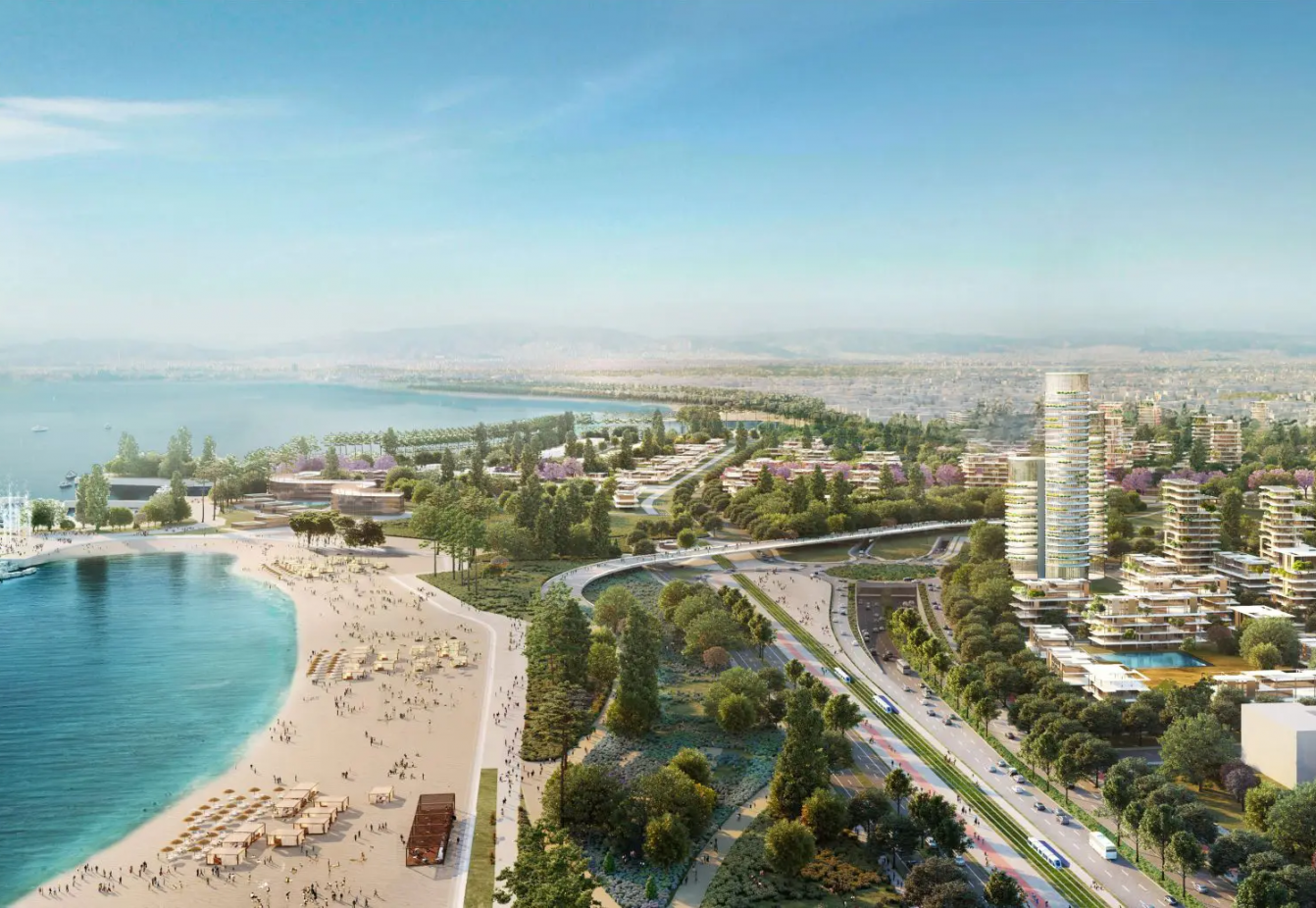
The Ellinikon is being built on the grounds of the former Athens international airport: 700 hectares of Mediterranean coastline transforming into one of the largest urban regeneration projects in Europe. Residential towers, hotels, retail, a marina, a metropolitan park. Tens of thousands of future residents.
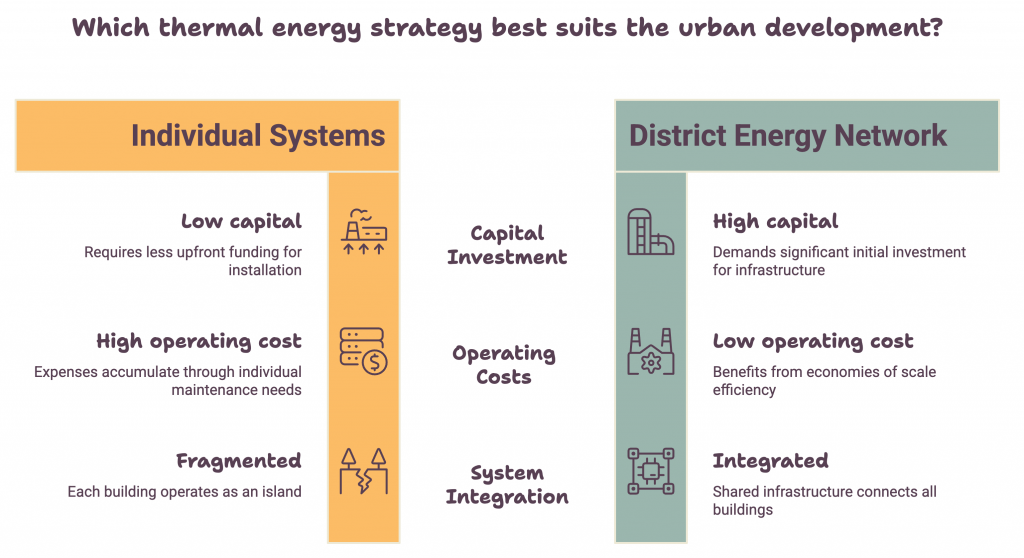
At this scale, the thermal energy question stops being an engineering specification and becomes a strategic fork in the road. Down one path: every building installs its own heat pumps, its own equipment rooms, its own maintenance contracts. Self-contained, familiar, fast. Down the other: a shared district network -centralized infrastructure that generates, moves, and trades thermal energy across the entire development as a single organism.
Both paths are defensible. Neither is obviously right. And the cost of choosing wrong compounds silently for 25 years.
The trap of the simple comparison
The intuitive way to compare these options is to price both and pick the cheaper one. That intuition fails here, for a reason that is easy to state and hard to model: the two options spend money in opposite directions.
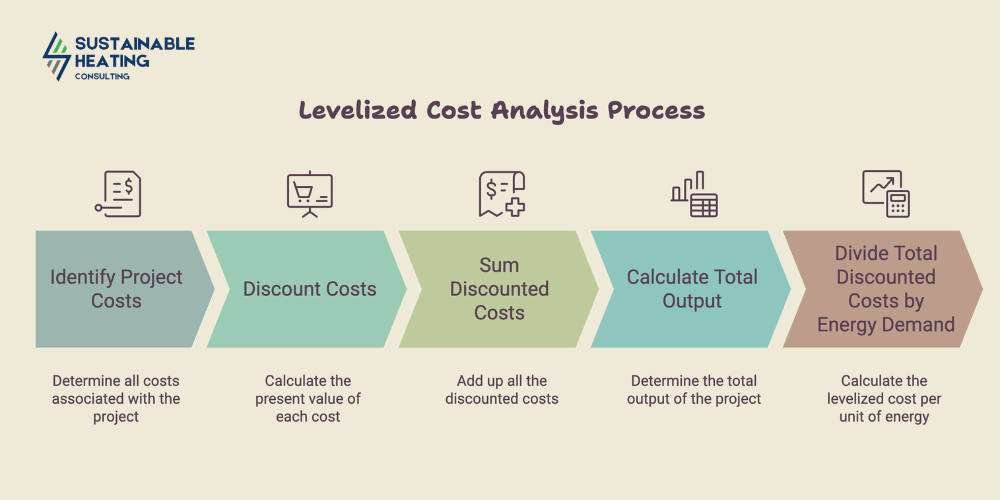
A district network demands heavy capital upfront -pipes, energy hubs, plant -and rewards you later with low operating costs and efficiency that individual systems cannot reach. Individual systems are cheap to start and expensive to live with: thousands of independent units, each with its own losses, its own service life, its own replacement cycle. Comparing them at any single moment in time gives you the wrong answer. The only honest comparison is across the entire life of the project, with every euro discounted to the same point in time. That is what levelized cost analysis does: it collapses 25 years of diverging cash flows into one number per option, finally making them commensurable.
But even that is not enough. Because The Ellinikon will not exist all at once.
Designing for a city that grows
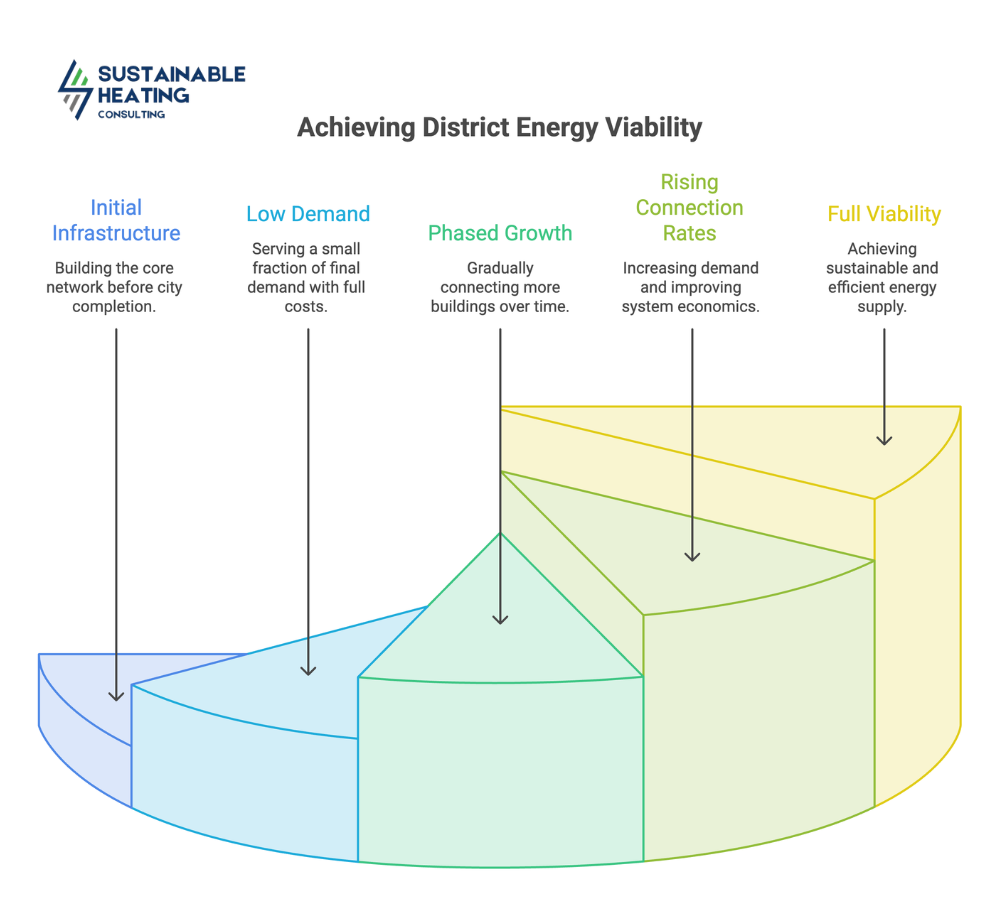
Districts are built in phases. Buildings come online over years, which means a district network spends its early life serving a fraction of its eventual demand. Infrastructure sized for the finished city runs underloaded through the years when its capital costs bite hardest. This is the quiet killer of district energy economics worldwide, and it had to sit at the center of the analysis rather than in a footnote.
So the question we modeled was never “which system is better?” It was “which system is better as the development grows” -with capital deployed in stages, demand ramping over time, and every scenario tested at hourly resolution across a full year. Eight thousand seven hundred sixty data points per scenario, because a system that looks efficient on an annual average can behave very differently during a July cooling peak or a quiet February weekend.
The Mediterranean changes the physics
Most of the district energy canon was written in Northern Europe, where the problem is heating and the solution is moving heat from a central plant to cold buildings. The Mediterranean inverts the problem. At The Ellinikon, cooling dominates – and heating and cooling demands coexist across much of the year. A hotel needs hot water at the same hour an office tower is rejecting heat.
This is exactly the condition where the newest generation of district networks becomes interesting. Fifth-generation systems operate near ambient temperature and let buildings trade thermal energy directly: one building’s waste heat becomes another building’s supply, with the network acting as the marketplace. Compared against fourth-generation systems – central plants, conventional temperatures, one-directional flow -the thermodynamic logic shifts fundamentally in a climate like this one.
Add the coastline itself: the sea is a vast, stable thermal reservoir sitting next to the site, with all the efficiency it could unlock and all the permitting complexity it carries. Add multiple candidate locations for the energy hubs, each with different land implications, pipe runs, and phasing logic. Add alternative sources -ground, sewage heat recovery, renewable power contracts – each deserving honest evaluation rather than fashionable endorsement.
The decision space was not a fork in the road. It was a landscape.
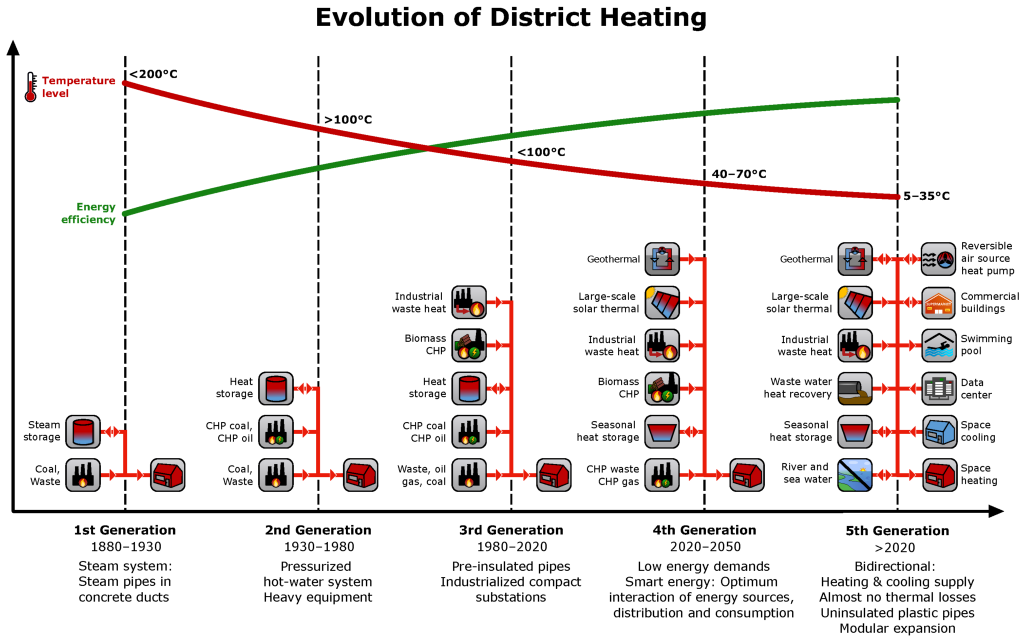
Source: Wirtz, M.; Kivilip, L.; Remmen, P.; Müller, D. Quantifying Demand Balancing in Bidirectional Low Temperature Networks. Energy Build. 2020, 224, 110245.
DOI: 10.1016/j.enbuild.2020.110245
From analysis to a decision framework
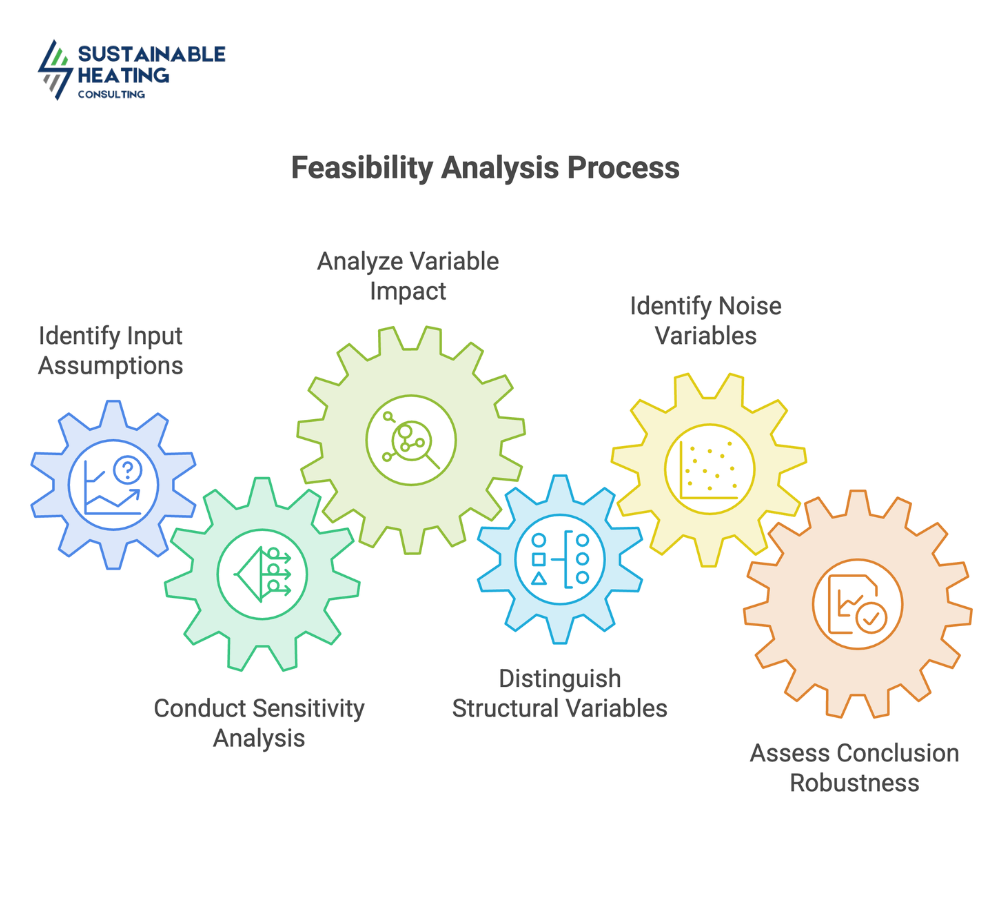
What does a developer actually need from a study like this? Not a single recommendation delivered with false confidence. Markets move, regulations shift, assumptions age. What decision-makers need is a map of the territory: which option leads under baseline conditions, which variables that conclusion depends on, and how far those variables can drift before the answer changes.
That is what sensitivity analysis is for. Electricity procurement costs, commercial margins, subsidy scenarios, electrical supply configurations -each tested across realistic ranges, not to generate more numbers, but to reveal which assumptions are structural and which are noise. The result is the difference between a report that gets filed and a framework that gets used: the client can now hold a negotiation, stress-test a term sheet, and revisit the conclusion as conditions evolve, without commissioning the work all over again.
By the end of this phase, the technical and economic case was clear. Which architecture fits this climate, this scale, this phasing. What residents would pay under each scenario, and how that compares to going it alone.
And yet the study answered only half the question.
The half that remains open
Knowing that a district network is the right technical and financial choice is not the same as knowing it can operate as a viable business. Those are different problems, and the second one is harder.
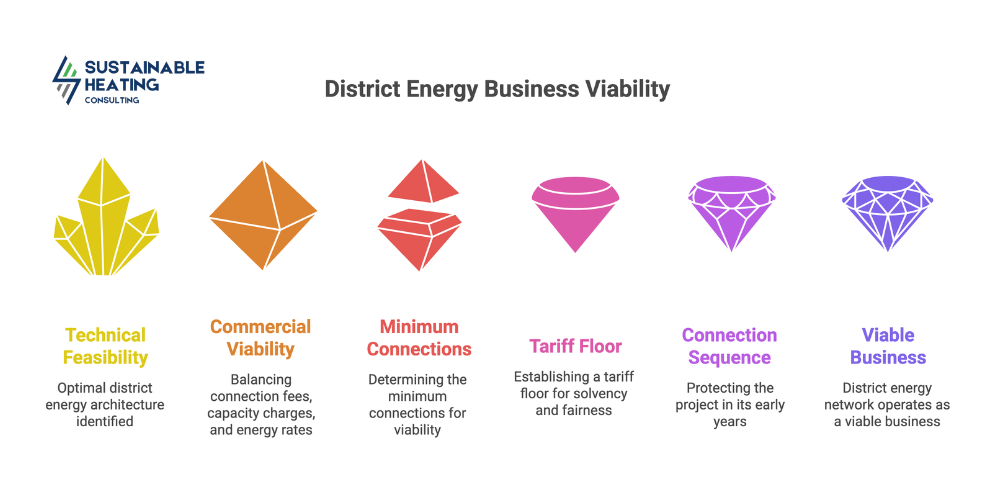
Whoever operates this infrastructure must recover its investment through what connected buildings pay – and that recovery rests on levers that do not move independently: upfront connection fees, recurring capacity charges, energy rates. The balance among them determines whether early-phase revenues can carry the capital before the development reaches maturity. History is blunt on this point: district energy projects rarely fail on thermodynamics. They fail on commercial structure.
How many connections does the network need, and by when, to stand on its own? Where is the tariff floor that keeps the operator solvent without pricing residents out of the very efficiency the system was built to deliver? Is there a connection sequence that protects the project through its most fragile years?
Those questions are open. They are the next frontier of this work -and in many ways, the more demanding one.
We work on these questions for developments where the energy decision has not yet hardened into concrete – the brief window where analysis still has leverage.
If your project is approaching that window, on either side of the question – system selection or commercial structuring – contact us
Tags: district energy, urban regeneration, 4G district heating, 5GDHC, The Ellinikon