
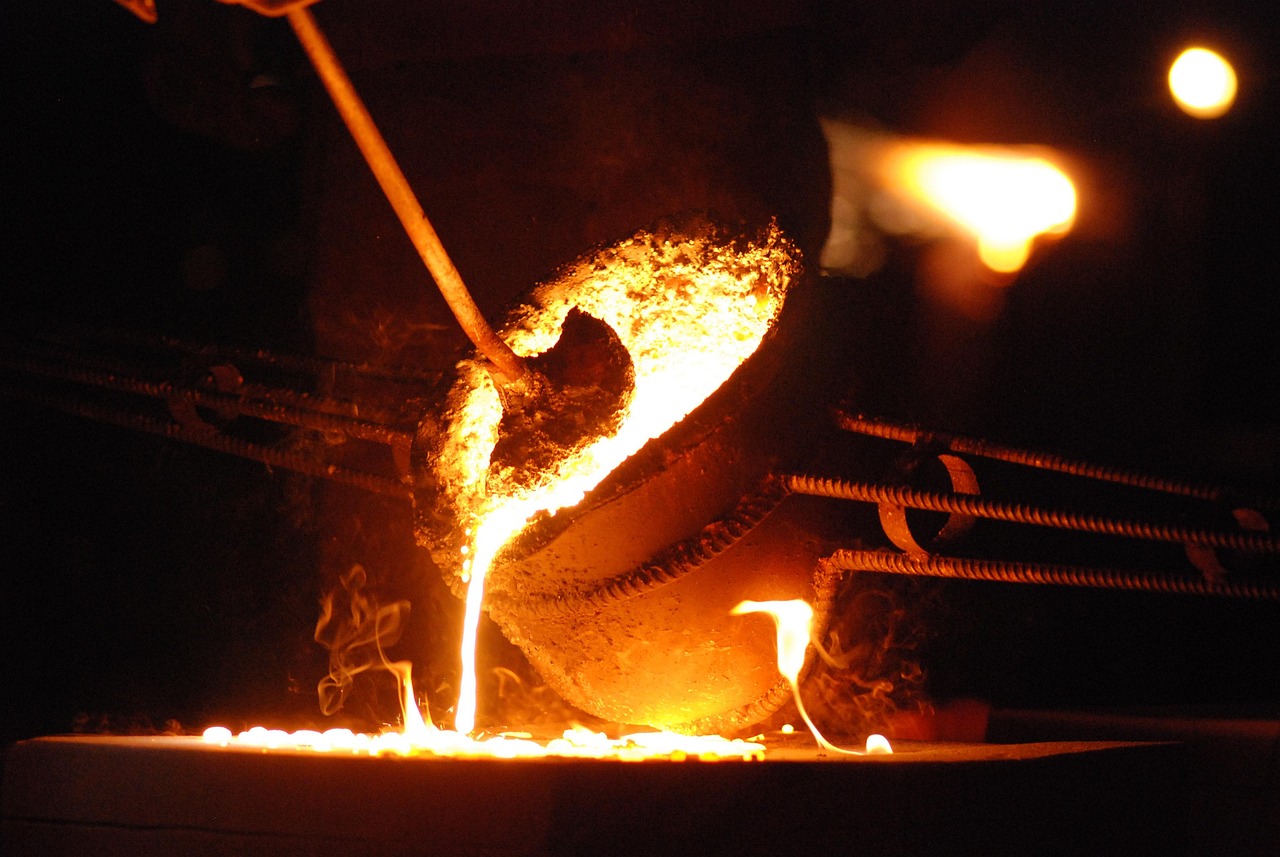
Explore how low-temperature waste heat enhances district energy using innovative heat pumps in Italy’s steel foundry systems.
In Italy, a steel foundry’s cooling system became a source of local energy. Using a low-temperature network operated by a local energy supplier and smart integration with decentralized heat pumps, they captured waste heat at just 25 °C and reused it for both district energy and internal heating needs.
After identifying the city of Ospitaletto (in the Lombardia region) as a promising case for industrial heat recovery (see Project Overview – Post 1), the technical challenge was clear: how to recover very low-temperature waste heat (~25 °C) and make it useful.
The solution combined low-temperature district energy with on-site heat boosting using decentralized heat pumps located at the users’ substations, mainly in schools.
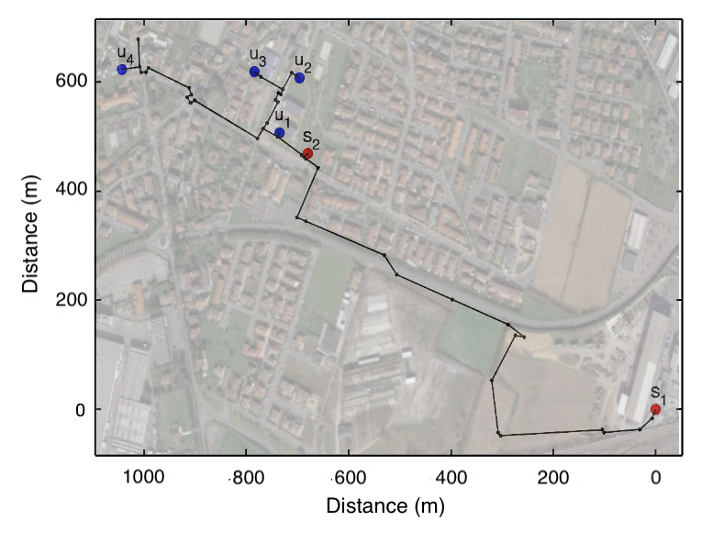
Network layout. Red circles indicate sources (s1, corresponding to the waste heat, and s2, corresponding to the aquifer wells), and blue circles indicate users. Distances are measured from the source s1. s = sources and u = users.S. Calixto, M. Cozzini, and G. Manzolini, “Modelling of an Existing Neutral Temperature District Heating Network: Detailed and Approximate Approaches” Energies, vol. 14, no. 2, Art. no. 2, Jan. 2021
How it works:
- The network has an extension of about 2 km, with a simple tree structure and a conventional 2-pipe system.
- The heat sources are provided by low-temperature waste heat taken from the cooling circuit of a steel mill (immediately before its connection with cooling towers) and by aquifer wells at a temperature of about 15°C.
- Waste heat from the steel foundry’s cooling system is recovered continuously at 25°C.
- It feeds into a cold network operated by a local energy provider, designed to handle temperatures as low as 15 °C.
- Decentralized substations with heat pumps raise the temperature to 60 °C, which is sufficient for heating spaces and providing hot water.
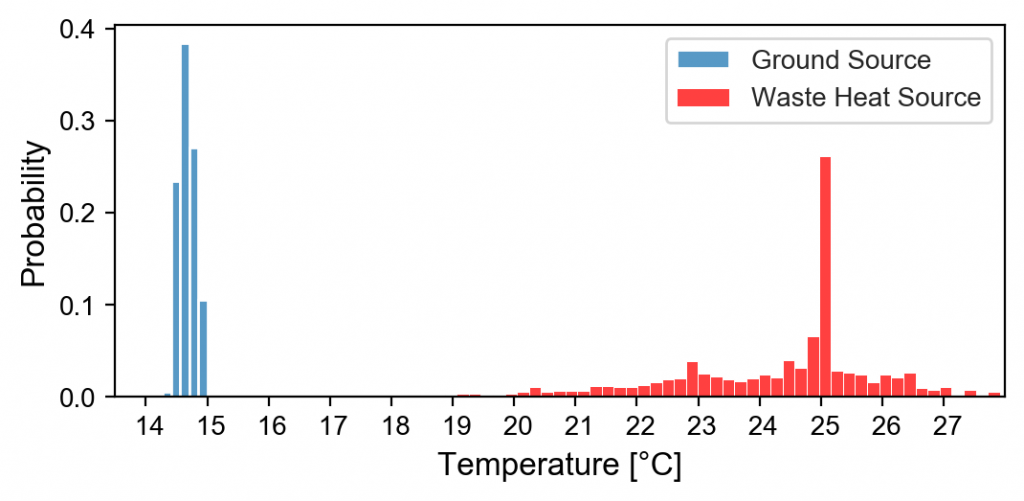
Probability histogram of sources temperatures in the period from Jan 13th to March 15th of 2020.
S. Calixto, C. Köseoğlu, M. Cozzini, and G. Manzolini, “Monitoring and aggregate modelling of an existing neutral temperature district heating network”. Energy Rep., vol. 7, pp. 140–149, Oct. 2021, doi: 10.1016/j.egyr.2021.08.162.
This setup allows for simultaneous external use (district energy) and internal reuse, all while maintaining high efficiency and minimal energy losses.
Why this matters:
- Dual-purpose use of waste heat reduces primary energy demand.
- It proves that 25 °C heat — often dismissed — can be reused cost-effectively.
- It’s a replicable model for other industrial processes across Europe.
In this contribution, the performance of a real neutral-temperature DH network was analyzed and compared with a model suitable for scenario analysis. The network relies on source temperatures between 15 and 25°C and exhibits an SPF of about 3.11. Large parts of the network pipes are uninsulated, nevertheless yielding thermal losses of the order of 30%. Electric pumping consumptions are of the order of 4% of the users’ thermal consumptions. The model provides proper order of magnitudes for these values even using simplified default estimates.
How we support your project
• Pre-Development Site Analysis
We assess potential sites for new developments, evaluating environmental impact, technical feasibility, and energy demand potential.
• Site and Master Planning
We design comprehensive decarbonization and energy transition plans for large-scale developments, campuses, or districts.
• Regulatory & Funding Alignment
We create actionable plans that align with compliance requirements, capital planning needs, and available funding mechanisms.
• Advanced Modeling & Simulation
We apply cutting-edge modeling tools to quickly simulate scenarios and identify high-impact, cost-effective solutions.
Our Approach
By combining high-resolution demand and infrastructure data with scenario modeling and compliance expertise, we help you develop investment-grade proposals, meet regulatory obligations, and plan long-term, low-carbon transitions.
Get in touch if you’re considering waste heat recovery
Want the technical deep dive? Peer-reviewed studies available upon request