
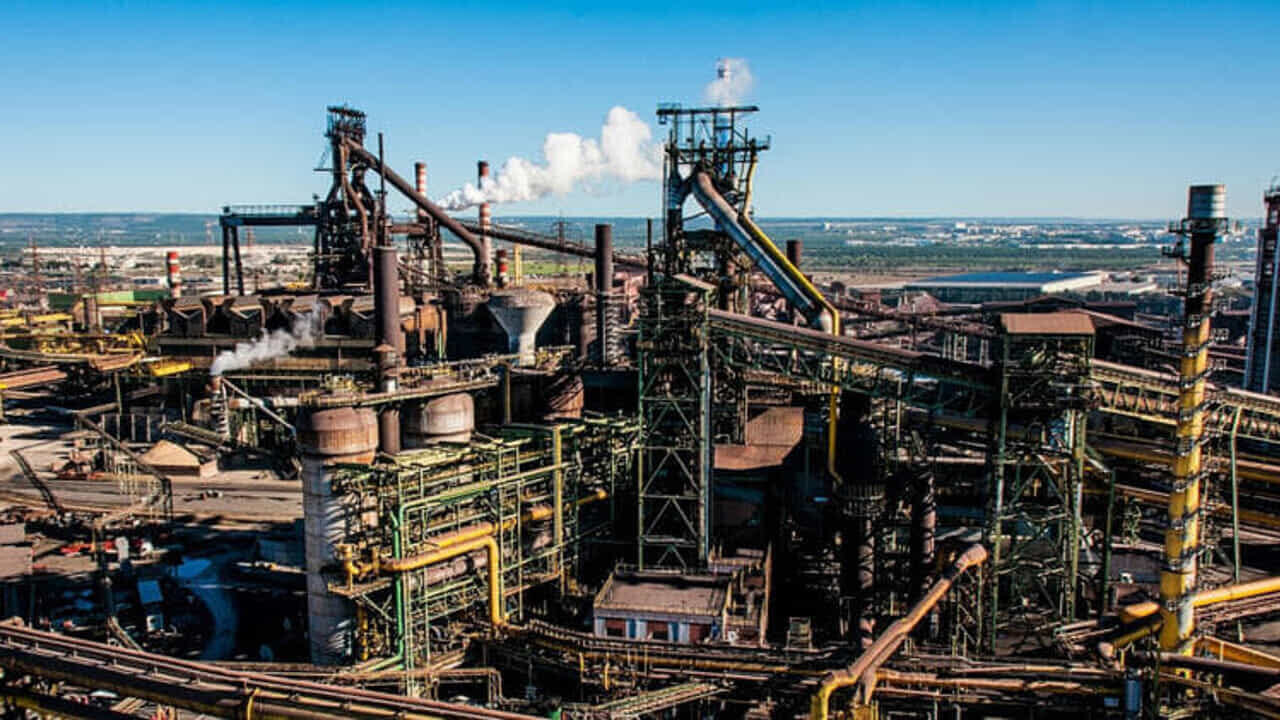
Identifying waste heat is only the first step. The real work is turning that potential into a technically rigorous, investment-grade design that stakeholders can act on.
This case study documents how Sustainable Heating applied high-resolution spatial simulation to a large-scale integrated steel plant — quantifying an untapped thermal resource, designing the distribution network, and producing a preliminary engineering package ready for funding and procurement.
The Context
Integrated steel plants are among the most energy-intensive industrial sites in Europe. They are also, paradoxically, among the most heat-rich: coking processes, blast furnace operations, and sinter plants generate enormous quantities of thermal energy that is routinely wasted — flared, vented, or lost to atmosphere.
For a major integrated steel complex in Southern Italy, we identified a consistent and recoverable source of 80°C waste heat from process steam condensation during the coking cycle. Rather than treating this as a byproduct problem, we framed it as a thermal infrastructure opportunity: a permanent, stable heat source capable of supplying an internal district heating network serving the facility’s 19 non-residential buildings.
The strategic logic was straightforward. The plant’s decarbonization roadmap requires transitioning away from fossil-fuel-based heating. A waste heat network eliminates that dependency — while simultaneously reducing the volume of industrial gases sent to safety flares, cutting harmful emissions at the source.
The Analysis
Using nPro, the German simulation platform purpose-built for district energy planning, we developed a preliminary design covering the full scope of technical and economic assessment.
Demand characterization: We modeled the thermal demand of all 19 buildings across the site with hourly resolution — 8,760 time steps per year — accounting for space heating profiles, domestic hot water requirements, process heat loads, and seasonal variation. The results:
| Annual energy | Peak power | |
| Space heating | 389,024 MWh | 66,452 kW |
| Domestic hot water | 477 MWh | 244 kW |
| Total thermal demand | 389,502 MWh | 66,526 kW |
Network design: We designed a 4 km buried distribution network connecting the primary heat source to 18 building connections, sizing each pipe section individually based on pressure drop limits and flow velocity constraints (per DIN EN 13941).
| Network properties | |
| Route length | 4 km |
| Distribution pipes | 3.5 km |
| Connection pipes | 0.5 km |
| Supply/return temperatures | 80°C/65°C |
| Pipe diameters | DN 25/ DN 700 |
| Linear heat density | 98 MWh/h |
| Site area | 111 ha |
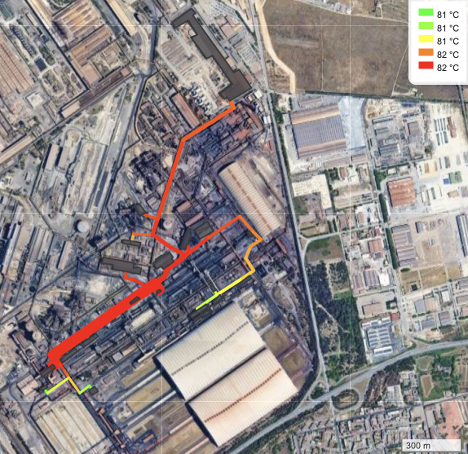
The linear heat density of 98 MWh/m is particularly significant. Industry thresholds for economic viability in conventional district heating start at 1.5 MWh/m. At 98 MWh/m — 65 times that threshold — the network’s economic case is exceptionally strong. This is the difference between a project that needs to be subsidized and one that stands on its own financial merits.
Heat source quantification: Beyond the main coking process source, we systematically evaluated the thermal potential of secondary heat streams across the plant — including sinter plant ancillary loads (estimated 19–57 MWh/h from the 80°C network, depending on season), blast furnace control infrastructure, and office and service buildings. Each building was modeled individually for heat demand, peak load, and network connection feasibility.
The Result
The preliminary design demonstrated that the proposed network could:
- Deliver 389,502 MWh/year of recovered waste heat to 18 building connections across 111 ha of industrial site
- Operate at a linear heat density of 98 MWh/m — well above any economic viability threshold
- Provide stable base-load operation from process heat, supplemented by seasonal space heating peaks
- Reduce industrial gas flaring by creating consistent internal demand for low-grade heat that would otherwise go to safety torches
- Displace fossil-fuel-based heating across warehouses, specialized production plants, control rooms, and offices
- Support future extension to adjacent facilities through spare hydraulic capacity built into the pipe sizing
The design was further optimized to minimize CAPEX through pipe diameter rationalization and to allow phased expansion as the facility’s energy transition progresses.
What This Type of Analysis Delivers
This is not a feasibility memo. It is an engineering package — spatial simulation, hydraulic design, demand quantification, and preliminary economic framing — that provides the technical foundation for:
- Investment decisions by plant operators or incoming industrial partners
- Funding applications to public programs (PNRR, JTF, Horizon Europe)
- Regulatory submissions requiring third-party technical validation
- Procurement processes for EPC contractors and equipment suppliers
The linear heat density metric alone is sufficient to clear most funding gatekeeping criteria. The hourly demand modeling provides the granularity needed for detailed engineering. The network layout is GIS-referenced and procurement-ready.
Why It Matters Beyond This Site
Waste heat recovery is one of the most underutilized levers in industrial decarbonization. Heavy industry — steel, cement, chemicals, ceramics — generates consistent, recoverable thermal energy at every site. In most cases, that energy is wasted not because recovery is technically impossible, but because no one has quantified it rigorously enough to make the investment case.
That is precisely what this type of analysis does.
If your industrial site has untapped thermal potential, we can take it from data to design.
Get in touch if you want to turn waste heat potential into a fully engineered, fundable solution.
Tags: industrial waste heat recovery · district heating design · steel industry decarbonization · energy efficiency in heavy industry · industrial DHC Italy